The
Boom Architecture Audit:
Articulating (Z) vs. Telescopic (S)
A Technical Analysis of Up-and-Over
Clearance, Working Envelopes, and Jobsite Utilization Logic.
In high-reach operations, choosing between an
**Articulating Boom** and a **Telescopic Boom** is a high-consequence engineering decision. It is the difference
between navigating a 15-meter pipe rack in a refinery and performing straight-line extension for a 50-meter
skyscraper façade.
For rental owners, it is also a Commercial
Calculation. Do you invest in the versatility of a Z-boom (Articulating) or the extreme verticality
of an S-boom (Telescopic)? This guide breaks down the **Working Envelope** physics and the **Sub-System
Mechanics** that define these two essential MEWP categories.
📑 Engineering Matrix
1. The Articulating (Z) Boom: Master of ‘Up-and-Over’ Clearance
The **Articulating Boom**, commonly referred to as a **Knuckle Boom** or **Z-Boom**, features multiple boom sections
that hinge. This geometry allows the machine to traverse a path that standard stick booms cannot—reaching **Up,
Over, and Around** obstacles.
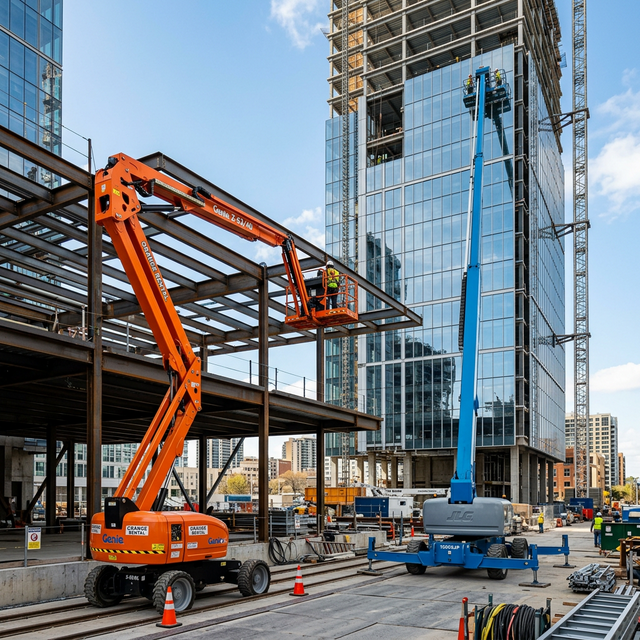
Precision: The dual-riser design of an articulating boom allows the operator to maintain the platform’s
verticality while the riser moves, essential for navigating refinery atriums or urban steel structures.
The technical advantage here is the Jib Flexibility. High-end articulating booms feature a 1.5m to
2.4m jib at the platform end, allowing for fine-tuned positioning without moving the main boom sections. This
minimizes the risk of Boom Oscillation during delicate maintenance tasks.
2. The Telescopic (S) Boom: Horizontal Outreach Supremacy
When the requirement is pure distance—either vertical or horizontal—the **Telescopic (S) Boom** is the industry
standard. Utilizing a single-cylinder extension mechanism, these booms provide significantly higher **Horizontal
Outreach** at full height compared to articulating models.
Key Technical Factor: The “Boom-Down” Reach
Telescopic booms can extend even at low angles, allowing them to reach across bridge decks or
shipyard pits where the chassis cannot be positioned closely. This **Straight-to-Work** extension speed
significantly boosts productivity on open construction sites.
3. Working Envelope Physics: Z vs. S Diagrams
A professional procurement audit always starts with the **Working Envelope Diagram**. This graphical representation
shows the total range of motion.
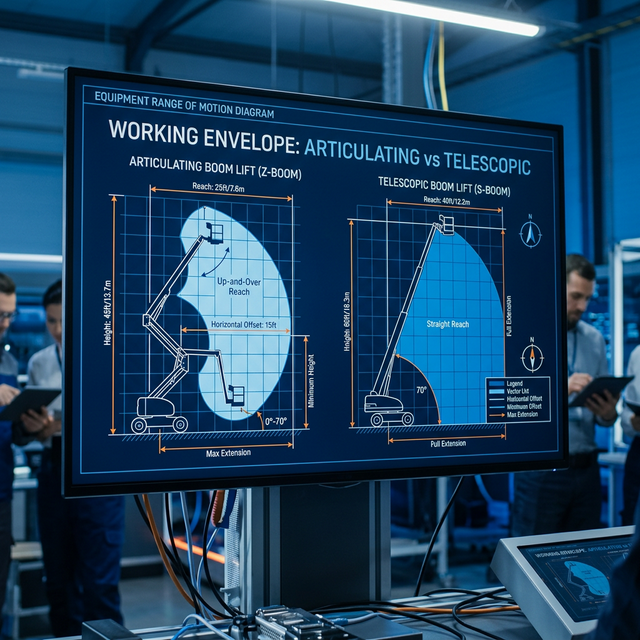
Analysis: Note how the Z-boom (left) has a ‘broken’ envelope allowing for interior pockets, while the S-boom
(right) has a larger overall volumetric reach but lacks the ‘dent’ for up-and-over access.
- Tailswing Management: Many articulating booms feature **Zero Tailswing**, allowing them to
rotate within the chassis width—critical for narrow city streets. - Chassis Footprint: Telescopic booms often require **Extending Axles** to provide the stability
base needed for extreme horizontal reach, increasing the required setup zone.
4. Strategic Utilization: Fleet Manager’s Selection Logic
From a **Total Cost of Ownership (TCO)** perspective:
- Articulating Booms generally have a higher rental utilization rate because they are versatile
enough for both indoor facilities management and outdoor construction. - Telescopic Booms command a higher daily rental rate but are often mission-specific (Stadiums,
Wind Turbines, High-Rise Façade).
Expert Selection Support by 陈船长独立站
Technical decisions in the AWP sector
require more than a brochure. We provide the technical content assets that build trust with high-intent
industrial buyers. Let us help you define your technical edge.
Related Technical Manuals: