The Ultimate Guide to Commercial Fiber Laser Cutting Machines
The Engineering & Procurement Masterclass for Heavy Manufacturing
Discover the core physics behind solid-state continuous wave lasers, analyze high-end kinematics, and master the ROI mathematics of heavy plate metal fabrication.
A few months ago, a procurement director for a Tier-1 automotive parts supplier called me from their factory floor in panic. Their newly acquired 6000W fiber laser cutting machine had just suffered a catastrophic nozzle crash while cutting a batch of warped, 8mm thick carbon steel chassis components. The collision not only shattered the protective glass cartridge but misaligned the entire autofocus laser head, causing $12,000 in direct damages and shutting down the production cell for four critical days.
The root cause? The purchasing department bought the machine based entirely on raw wattage and a cheap sticker price, completely ignoring the lack of an active anti-collision array and the substandard kinematics controlling the Z-axis.
In the world of B2B heavy manufacturing, the true cost of a fiber laser cutting machine (光纤激光切割机) is never just the upfront capital expenditure (CapEx). It is the cost of downtime, the hidden burden of high post-weld reworking rates, and the silent profit killer of poor wall-plug electricity efficiency.
Whether your facility is processing automotive transmission components, dual clutch units, or mass-volume architectural structural steel, you are not buying a laser—you are buying 24/7 process stability. A commercial-grade fiber laser must execute identical, microscopic focal diameters for thousands of hours without thermal degradation or mechanical drift.
In this comprehensive guide, you will learn exactly how physical photonics translate into cutting power, what mechanical components (from Yaskawa servomotors to dual-circuit chillers) separate a true industrial machine from a toy, and how to definitively calculate your equipment ROI before making a bulk OEM order.
📑 Table of Contents
How Fiber Lasers Work: The Physics Explained
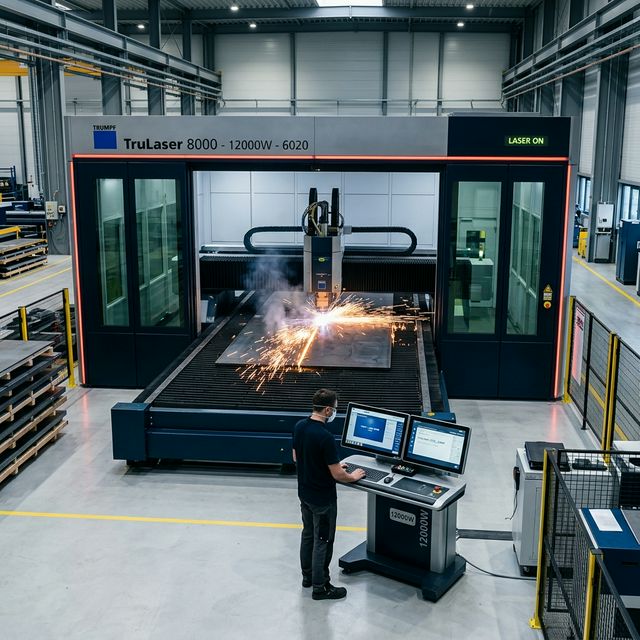
To understand why fiber lasers have essentially eradicated legacy CO2 lasers from the modern metal fabrication floor, we must first look at the physics of solid-state light generation.
1. Solid-State Pumping
Unlike CO2 lasers which excite a gas mixture inside a fragile glass tube, a fiber laser creates its beam completely in a solid state. Banks of semiconductor laser diodes emit light pulses into an active optical fiber. This active fiber is doped with rare-earth elements, most commonly Ytterbium (Yb) for high-power metal cutting. As the pump light bounces through this doped core, it excites the Ytterbium ions, amplifying the light exponentially through stimulated emission.
2. The 1.06 µm Wavelength Advantage
Why does the wavelength matter to a factory manager? Because of material absorption. A fiber laser operates at a wavelength of approximately 1.06 micrometers (µm). This near-infrared wavelength is highly absorbed by metals—up to 100 times better than the 10.6 µm wavelength of a CO2 laser. When the beam hits carbon steel, stainless steel, or highly reflective materials like copper and aluminum, the metal absorbs the energy immediately, melting furiously quickly. This creates a phenomenally fast piercing time and an incredibly narrow heat-affected zone (HAZ).
3. Flexible Beam Delivery (飞行光路)
Once generated, the intensified laser beam is guided down a flexible fiber optic cable directly into the cutting head. There are no expensive, easily misaligned mirrors involved in delivering the beam. This “flying optical path” (飞行光路) means the massive gantry above the cutting bed can accelerate at 1.5G or 2.0G without vibrating any fragile mirrors out of alignment, ensuring the focal point remains absolutely perfect across a 6-meter bed.
Quick Recaps:
- Solid-State Generation: No consumable laser gases required; highly stable diode banks.
- Optimized Wavelength: 1.06 µm is absorbed by metal instantly, enabling high-speed cutting of highly reflective copper and brass.
- Mirrorless Delivery: Eliminates optical misalignment, massively reducing maintenance overhead.
- Honest Limitation: The 1.06 µm wavelength passes straight through clear acrylic, glass, and wood without cutting them. Fiber lasers are strictly for metal processing.
- Perfect for: High-volume sheet metal fabricators, automotive OEM part suppliers, and aerospace structural engineering.
The Core Anatomy of a Commercial Flatbed Cutter
A high-performance laser beam is useless if the mechanical chassis moving it cannot maintain sub-millimeter tolerances. When specifying procurement requirements for a commercial machine, engineers look strictly at three structural pillars.
1. High-End Kinematics (Motion Control)
To cut complex geometries at a linkage speed of 100+ meters per minute, the gantry requires immense power and absolute rigidity. This is primarily achieved using Japanese Yaskawa Servomotors (安川伺服电机). These motors provide incredible torque with virtually zero backlash when paired with premium rack and pinion (齿轮齿条) systems and linear guides from brands like HIWIN or YYC.
The Procurement Benchmark:
- Positioning Accuracy: ±0.03 mm/m. Crucial when parts are meant to go directly to automated welding without post-process grinding.
- Repositioning Accuracy: ±0.02 mm. Ensures part #1000 is identical to part #1.
- Acceleration: 1.5G or higher. Rapid acceleration dictates how fast the machine can pierce and move between cutting vectors.
2. Dual-Circuit Industrial Water Chillers
Cutting thick metal generates radiant heat that threatens to warp the heavy steel machine bed and overheat the laser optics. Commercial tier machines utilize a dual-circuit industrial water chiller. This system simultaneously, yet independently, cools the fiber laser source (which requires a stable internal temperature for diode longevity) and the laser cutting head (which is exposed to intense molten metal blowback). Thermal stability directly defines the lifespan of your protective glass cartridge.
3. Modular Heavy-Duty Machine Beds
Why do commercial machines weigh upwards of 12,000 lbs? Because vibration is the enemy of the focal point. Machine beds must be welded from thick structural steel plates, subjected to thermal stress relief annealing (to prevent the frame from warping months later), and machined on a heavy gantry mill. This provides the immense mechanical stiffness required to support high-G acceleration.
Quick Recaps:
- Premium Kinematics: Yaskawa Servomotors and HIWIN linear guides ensure ±0.03 mm/m accuracy.
- Dual-Circuit Cooling: Separate cooling loops for the laser source and cutting head prevent catastrophic thermal degradation.
- Heavy Steel Beds: Annealed chassis absorb vibrations during 1.5G high-speed directional changes.
- Honest Limitation: Heavy gantry beds are incredibly difficult and expensive to ship securely overseas, requiring specialized flat-rack containers or meticulous teardowns.
- Perfect for: 24/7 continuous operation in heavy manufacturing environments where downtime is unacceptable.
1500W to 24000W: The Power Selection Matrix
One of the most common mistakes B2B buyers make is over-purchasing or under-purchasing laser power. Upgrading from 3000W to 12000W is not just about the ability to cut thicker metal—it is about cutting your average thickness 400% faster with a cleaner edge profile that requires zero deburring.
| Laser Power | Ideal Industry Applications | Max Processing (Carbon Steel) | Max Processing (Stainless Steel) |
|---|---|---|---|
| 1500W – 3000W | HVAC ducting, electrical cabinets, kitchenware, light job shops. | 16mm – 20mm | 8mm – 10mm |
| 4000W – 8000W | Automotive parts, agricultural machinery, elevator manufacturing. | 25mm – 30mm | 20mm – 25mm |
| 10000W – 24000W+ | Shipbuilding, structural steel beams, heavy equipment frames, toll cutting. | 40mm – 60mm+ | 40mm – 50mm+ |
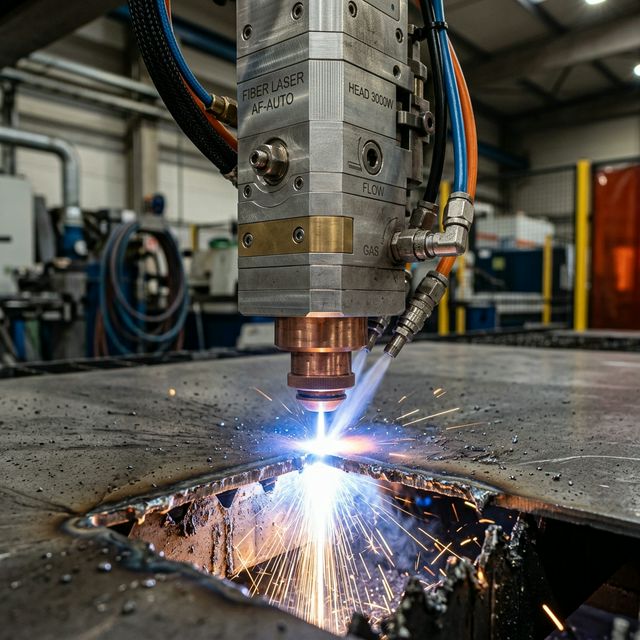
Ultra-High Power Dynamics: When you push beyond 10,000W, the laser focusing optics must fundamentally change. These high-power heads feature multifocus elements designed to create gas-tight weld seams and utilize complex shielding gas nozzles (handling high-pressure nitrogen or oxygen mixtures) to instantly evacuate molten slag from deep trenches.
Quick Recaps:
- Low Power (1.5-3kW): Excellent for high-speed cutting of thin gauge sheet metal.
- Ultra-High Power (10kW+): Essential for thick carbon/stainless plates, prioritizing extreme edge quality and processing speed.
- Optics Scaling: As wattage increases, the focusing optics become significantly more complex, requiring MVE nozzles and heavy duty crossjet functions.
- Honest Limitation: A 24,000W laser consumes a massive amount of electrical power and requires vast volumes of high-purity auxiliary cutting gas, which will heavily skew daily operating costs.
- Perfect for: Aligning machine specs directly to the facility’s 80% median material thickness.
Smart Sensors: OCT & Active Anti-Collision
In modern autonomous factories, cutting power is worthless if the machine cannot protect itself while running “lights-out” shifts. True commercial-grade machines employ proprietary operating systems equipped with intelligent monitoring interfaces.
Active Anti-Collision (主动防碰撞)
When cutting nested parts on a large steel sheet, internal stresses can cause freshly cut pieces to warp or tilt upward. If a gantry moving at 100 m/min collides with a tilted piece of steel, the laser head is destroyed. Active Anti-Collision arrays utilize capacitive sensors around the nozzle 360-degrees. The system detects the warped steel milliseconds before impact and instantly retracts the Z-axis, maneuvering safely around the obstacle.
Optical Coherence Tomography (OCT) & Depth Monitoring
Increasingly integrated into 3D 5-Axis systems that transition between cutting and welding, camera and OCT systems form perfect units for 3D characteristics recognition. They map the surface topography of the metal in real-time. Depth monitors warn operators if the process deviates from preset melting depths, automatically adjusting laser power output to compensate for material impurities or expansion/contraction (涨缩补偿).
Quick Recaps:
- Anti-Collision: Capacitive sensors physically prevent the laser head from crashing into warped metal parts.
- OCT Systems: Provide microscopic topographical mapping for flawless transition into robotic welding.
- Real-time Auto-correction: Prevents massive batches of scrap by adjusting focal depth on the fly.
- Honest Limitation: Proprietary sensors often lock you into the manufacturer’s specific operating system ecosystem (e.g., BodorThinker), making third-party aftermarket repairs difficult.
- Perfect for: Automation and robotics integrators building heavily automated, low-human-intervention production cells.
The Business Case: Maximizing Operational ROI
The global fiber laser cutting machine market is expanding precisely because the technology guarantees a dominant return on investment compared to legacy punching machines, plasma cutters, and CO2 lasers.
For B2B manufacturing investors, the ROI formula goes far beyond the sheet cutting speed. It involves massive reductions in electrical overhead—fiber lasers boast a 30% to 40% wall-plug power efficiency compared to a CO2 laser’s miserable 8% to 10%. Furthermore, by eliminating the need for routine mirror alignment and laser gas replacement, dedicated maintenance labor drastically drops.
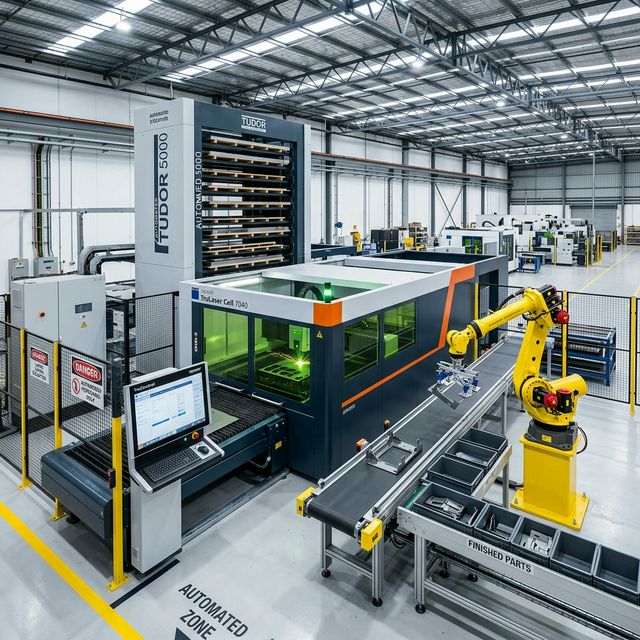
To maximize this capital investment, leading facilities implement pallet changers (exchange tables). While the laser is actively processing sheet A inside the safety cabin, the operator (or automated loading crane) is simultaneously unloading completed parts and loading fresh metal onto sheet B outside the machine. This allows the laser to achieve over 90% active arc-on time during a 12-hour shift, paying for the chassis in as little as 14 to 18 months in a high-volume job shop.
Looking for a Reliable OEM Laser Partner?
The biggest risk in sourcing heavy machinery from overseas is navigating the sea of trading companies masquerading as assembly engineers. At 陈船长独立站, we guide major industrial distributors and procurement boards to the premier OEM laser automation partners.
If you are upgrading your automotive fabrication line or establishing a massive regional toll-cutting facility, you need direct access to factories building commercial-grade equipment loaded with genuine Yaskawa servomotors, Precitec/Raytools autofocus heads, and dual-circuit industrial chillers.
We provide exclusive procurement insights, B2B digital content strategy, and connection to top-tier factory direct pipelines that hold ISO9001, CE, and FDA compliance scaling from standard 1500W flats to 24000W fully automated cells.
Conclusion & Technical Notes
A commercial fiber laser cutting machine acts as the heartbeat of modern metal fabrication. When evaluating a potential machine, look past the outer casing and analyze the deep engineering specs: the rigidity of the heavy steel bed, the acceleration thresholds of the servomotors, and the intelligence of the active anti-collision arrays. By selecting a machine with the correct wattage and genuine premium components, your facility can ensure zero-downtime manufacturing and vastly outpace legacy operations.