Fiber Laser vs. CO2 Laser: The Engineering and ROI Comparison
The Definitive Guide for Sheet Metal Procurement Boards
Bypass the marketing jargon and compare the sub-atomic physics, wall-plug efficiency metrics, and maintenance realities of Fiber versus CO2 metal processing.
A decade ago, carbon dioxide (CO2) lasers were the undisputed lords of the metal fabrication floor. Their massive, hissing gas turbines and delicate optical mirror pathways were synonymous with “high-tech” manufacturing. Fast forward to 2026, and a walk through any modern Tier-1 automotive parts supplier or heavy structural steel plant reveals an entirely different ecosystem: rows of sleek, enclosed machines utilizing solid-state fiber lasers (光纤激光器). The shift has been absolute, sudden, and unforgiving to legacy CO2 manufacturers.
But does that mean CO2 is completely dead? If you are a procurement manager tasked with expanding a commercial sheet metal processing facility, or an automation integrator building a robotic welding cell, which technology legitimately offers the fastest amortization schedule?
Choosing the wrong laser equipment is a multi-million dollar mistake. Buy a CO2 laser for thin sheet metal, and you will bleed thousands of dollars monthly in wasted electricity and laser gas. Buy a fiber laser to process massive blocks of clear acrylic, and the beam will simply pass straight through the plastic like a harmless flashlight.
In this technical breakdown, we strip away the sales pitch. We will compare fiber laser cutting machines directly against CO2 cutters by analyzing their core physics of photon generation, true wall-plug efficiency (WPE), speed matrices for various metal gauges, and the brutal reality of 24/7 commercial maintenance parameters. In this guide, you’ll learn exactly which machine maximizes ROI for your specific industrial application.
📑 Table of Contents
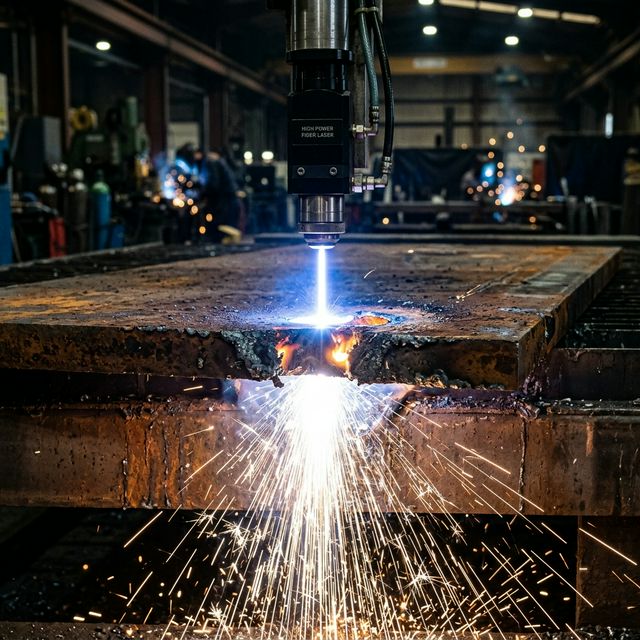
The Physics: Gas Excitation vs. Solid-State Pumping
The primary difference between these technologies stems from how the laser beam is physically generated and subsequently delivered to the workpiece.
CO2 Lasers: The Legacy Approach (10.6 µm Wavelength)
A CO2 laser excites a gas mixture (primarily carbon dioxide, balanced with nitrogen and helium) inside a sealed or flowing glass tube using large electrical RF (radio frequency) inputs to generate a beam. This invisible beam operates at a wavelength of approximately 10.6 micrometers (µm).
Once generated, this beam must travel to the cutting head over open air. To do this, it bounces off multiple exceptionally pure, gold-coated or silicon mirrors across a moving gantry. This “open optical path” requires completely dust-free internal bellows and perfectly aligned mirrors. If the gantry shakes violently during acceleration, the mirrors misalign, scattering the focal point and halting production.
Fiber Lasers: The Solid-State Revolution (1.06 µm Wavelength)
A commercial fiber laser generates its beam using monolithic banks of semiconductor laser diodes. This seed light is amplified through a flexible, active optical fiber coated in rare-earth elements like Erbium or Ytterbium. Because the entire generation process happens inside solid glass and fiber—with no moving parts and no gas mixture—it is completely sealed from the factory environment.
The resulting beam operates at 1.06 µm, exactly ten times shorter than a CO2 beam. Furthermore, the beam is delivered directly into the autofocus laser head through a flexible armored fiber optic cable. There are exactly zero delivery mirrors. This “flying optical path” (飞行光路) makes the machine immune to high-G vibrations.
Quick Recaps:
- Beam Generation: CO2 relies on high-maintenance gas tubes; Fiber relies on maintenance-free solid-state diodes.
- Beam Delivery: CO2 uses delicate mirrors spanning the gantry; Fiber channels light safely through extreme-flexibility cables.
- Vibration Immunity: Fiber lasers can operate at 1.5G+ accelerations; CO2 lasers require slower accelerations to protect mirror alignment.
- Honest Limitation: If a high-power fiber optic cable is accidentally severed or internally burnt through contamination, replacing the entire cable is a massive, highly technical expense compared to swapping a single CO2 mirror.
- Perfect for: High-speed sheet metal processing environments where constant G-force trauma on the gantry is standard operating procedure.

The Cutting Speed Matrix: Thin vs. Thick Metals
Engineering physics dictates that materials absorb different wavelengths of light at different efficiencies. Because the fiber laser’s 1.06 µm wavelength is heavily absorbed by metals, the photon energy instantly converts into melting heat. The CO2’s 10.6 µm wavelength is mostly reflected by the surface of bare metal until the metal is heated to a critical point.
Thin to Medium Sheet Metal (1mm – 10mm)
In this range, a fiber laser utterly destroys a CO2 laser. A standard 3000W fiber cutter equipped with high-end Yaskawa servomotors will process 3mm carbon steel or stainless steel roughly 2x to 3x faster than an identically powered CO2 laser. The pierce time is virtually instantaneous, and the cutting speed is blistering. This is why the entire 3C electronics and HVAC ducting industries have universally abandoned CO2.
Ultra-Thick Plate Processing (30mm+)
Historically, CO2 lasers held an advantage when cutting extremely thick steel (over 25mm), as their wavelength produced a slightly smoother, vertical edge profile without striations. However, with the advent of 24,000W and 30,000W ultra-high power fiber lasers equipped with multi-focus optics and MVE shielding gas nozzles, this gap has been completely closed. A high-power fiber laser now matches the edge quality of a CO2 machine while cutting thick plates significantly faster.
Quick Recaps:
- Thin Metal: Fiber lasers are 2x to 3x faster than CO2 lasers, providing a drastic throughput advantage.
- Thick Metal: High-wattage (12kW+) fiber lasers have effectively closed the historic edge-quality gap held by legacy CO2 machines.
- Honest Limitation: To cut ultra-thick metal cleanly with a fiber laser, facilities must invest in 24,000W+ models, requiring a massive initial CapEx and heavy dual-circuit cooling infrastructure.
- Perfect for: High-volume OEM manufacturers processing thousands of thin-gauge electrical cabinets or automotive components daily.
The Danger of Highly Reflective Metals (EV Batteries)
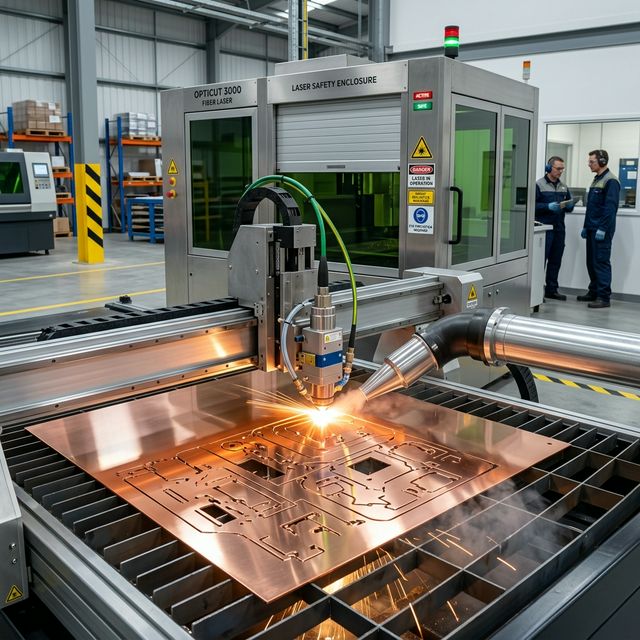
As the EV (Electric Vehicle) battery sector explodes globally, manufacturing plants are processing exponentially more copper, brass, and aluminum. These materials pose an existential threat to CO2 lasers.
When a CO2 beam hits a sheet of highly reflective copper, a large portion of the 10.6 µm wavelength fails to penetrate the surface. Instead, it reflects backward. Because a CO2 laser uses an open optical path, this high-energy back-reflection travels straight back up the mirror system and shatters the delicate optics inside the laser resonator, destroying the machine.
A fiber laser’s 1.06 µm wavelength is instantly absorbed by copper. Furthermore, any minimal back-reflection is safely mitigated by optical isolators built into the solid-state architecture. For industries cutting copper busbars or welding aluminum EV battery casings, the fiber laser is the only physically viable technology.
Maintenance and Wall-Plug Operational ROI
Procurement boards must analyze electrical draw to calculate true profitability over a 5-year operating lifecycle.
1. Electrical Wall-Plug Efficiency (WPE)
A standard CO2 laser has an abysmal WPE of 8% to 10%. This means to generate 4,000 watts of cutting power, the machine draws nearly 40,000 watts of electricity from the grid. It wastes the rest as massive radiant heat, requiring equally massive turbine chillers to keep the gas tube from melting.
A modern fiber laser possesses a WPE of 30% to 40%. A 4,000W fiber laser will only draw roughly 12,000 watts from the wall. This staggering difference in electrical efficiency slashes monthly utility overhead by up to 60%, drastically accelerating the machine’s ROI timeline.
2. Eliminating Consumable Labor
Operating a CO2 laser requires a dedicated technician to constantly monitor and supply expensive laser gases (He, N2, CO2), align mirrors using specialized tools, and rebuild the vacuum turbine blowers every few thousand hours.
A fiber laser has virtually zero structural maintenance. Aside from wiping down the HIWIN linear guides, the operator only needs to swap the protective glass cartridge inside the cutting head (a 60-second procedure) and ensure the dual-circuit water chiller remains filled. There is no laser gas, no mirrors, and no vacuum turbines.
The Business Case: Which Should You Buy?
Let us be absolute in our recommendation:
If you are cutting metal (Carbon Steel, Stainless Steel, Aluminum, Copper, Brass), you must purchase a Fiber Laser. The massive advantages in 3x cutting speeds, 40% electrical efficiency, and near-zero structural maintenance have rendered CO2 obsolete for commercial metal fabrication.
However, CO2 lasers still reign supreme for NON-METALS. Remember the 1.06 µm wavelength physics? A fiber laser beam passes harmlessly through clear plastic. If your facility is a signage company processing 20mm thick clear acrylic, plywood, leather, textiles, or MDF boards alongside your metal components, a lower-power CO2 laser remains the undisputed tool of choice for those organic materials.
Transitioning a legacy sheet metal facility from outdated plasma and CO2 systems to autonomous fiber laser technology requires a verified OEM partner. At 陈船长独立站, we align B2B distributors and factory procurement boards directly with the elite echelon of China’s fiber laser manufacturing tier.
Avoid the pitfalls of sourcing through trading companies. We secure OEM machines outfitted with genuine Yaskawa kinematics, proprietary anti-collision Operating Systems, and high-amp dual circuit chillers tailored specifically for your material thickness and regional power grid requirements.
Conclusion & Sourcing Checklist
The battle between Fiber and CO2 lasers ended half a decade ago for the metalworking industry. The fiber laser’s solid-state physics inherently provide devastatingly fast processing speeds, immunity to high-G mechanical vibration, and unprecedented electrical efficiency.
When you prepare to procure your fiber laser equipment, ensure you specify your average daily material thickness (to avoid over-purchasing wattage), demand precision ±0.03 mm/m rack and pinion alignments, and install an automated exchange table (pallet changer) to keep the arc-on time above 90% during your facility’s daily operations.