Articulating vs. Telescopic Booms: Which Fits Your Jobsite?
A Technical Comparison for High-Reach Efficiency and
ROI
Choosing the right boom lift isn’t just about
height—it’s about navigating the ‘Up-and-Over’ challenge versus the ‘Straight-to-Source’ extension.
When your project requires reaching heights of 60, 80, or even 150 feet, a standard scissor lift simply won’t
suffice. You enter the territory of Boom Lifts. However, for procurement managers and site
supervisors, a critical question remains: Should you invest in an Articulating Boom (Z-Boom) or
a Telescopic Boom (S-Boom)?
The wrong choice can lead to significant delays. A telescopic boom might reach the height but lack the
flexibility to reach over a complex steel structure. Conversely, an articulating boom might provide the
“knuckle” flexibility but fall short on the horizontal outreach required for bridge or stadium work.
In this article, we break down the engineering logic, site-specific advantages, and the ROI implications of these
two powerhouse MEWPs, helping you select the right asset for your fleet.
📑 Strategic Comparison: Table of
Contents
Articulating Booms: The Precision ‘Up-and-Over’ Solution
Often referred to as **Knuckle Booms** or **Z-Booms**, articulating boom lifts feature multiple sections that hinge
or “articulate.” This allows the operator to reach up, over, and around obstacles such as ductwork, structural
beams, or machinery.
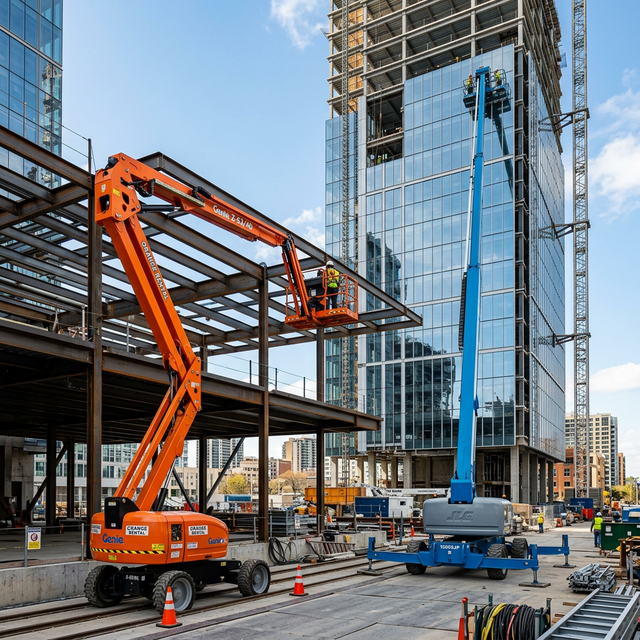
both machines reach high, the articulating boom (left) excels in reaching over complex structures, while the
telescopic boom (right) provides unmatched straight-line reach.
The primary advantage of articulating booms is their Tight Turning Radius and Zero
Tailswing (on many compact models). This makes them indispensable for indoor industrial maintenance,
HVAC repairs, and congested urban construction sites where space is at a premium.
📋 Quick Recaps: Articulating Booms
- Unmatched flexibility for maneuvering around obstacles
- Compact footprint ideal for tight or indoor jobsites
- Lower overall tailswing for safer operation in high-traffic zones
- Honest Limitation: Generally offer less horizontal outreach than
telescopic models of the same vertical class.
Telescopic Booms: Maximum Outreach and Horizontal Extension
If articulating booms are about precision, Telescopic Booms (S-Booms) are about power and scale.
These booms extend straight like a telescope, offering the highest vertical reach and the most significant
horizontal outreach in the MEWP family.
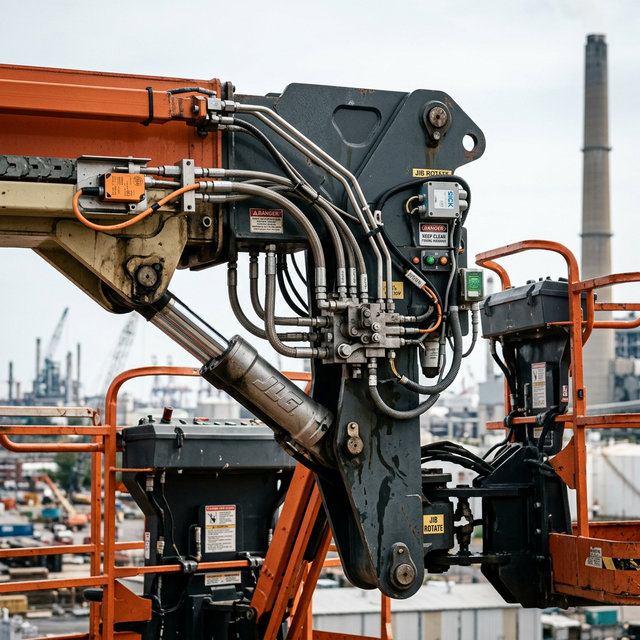
large-scale infrastructure projects.
For stadium construction, shipyard maintenance, or exterior window installation on high-rise buildings, the
Horizontal Outreach of a telescopic boom is its biggest selling point. While it requires more space
to operate (due to a larger footprint and significant tailswing), its simplicity and speed of extension are
unmatched.
📋 Quick Recaps: Telescopic Booms
- Industry-leading horizontal outreach and vertical height
- Faster extension speed; ideal for “Straight-to-Work” scenarios
- Greater stability for high-capacity platform work at extreme heights
- Honest Limitation: Requires a larger “clearance zone” due to
tailswing; cannot reach “over” obstacles easily.
Performance Matrix: Articulating vs. Telescopic
Metric |
Articulating (Z-Boom) |
Telescopic (S-Boom) |
|---|---|---|
| Obstacle Navigation | Excellent (Up-and-Over) | Limited (Straight Line Only) |
| Work Area Reach | Highly Versatile / Multi-Directional | Maximum Distance / Extension |
| Jobsite Footprint | Small / Tight Access Friendly | Large / Requires Open Space |
| Extension Speed | Moderate (Multi-section unfold) | Fast (Single Cylinder Extension) |
B2B Buying Logic: Utilization vs. Maintenance
For fleet managers, the “best” boom lift is the one that stays on rent. **Articulating booms** generally see more
diverse rental requests because they can handle both industrial maintenance and light construction. **Telescopic
booms** are higher-ticket rentals, typically demanded for specialized, large-scale infrastructure projects.
Total Cost of Ownership (TCO) also differs. Articulating booms have more hinge points and bearings,
requiring more frequent mechanical inspections. Telescopic booms have simpler extension systems but require rigorous
inspection of the internal cable tracks or boom chains.
About
陈船长独立站
陈船长独立站 provides specialist content
strategy for global B2B industrial manufacturers. We bridge the gap between technical engineering and
high-intent SEO content.