A Comprehensive Guide to Smart Glasses – All You Need to Know
The B2B Seller’s Guide to the Wearable Eyewear Revolution
Explore how AR, AI, and smart audio frames are transforming the consumer electronics space, and how to position your brand for explosive growth.
The wearable technology landscape is shifting. While smartwatches and fitness trackers have dominated the wrist for over a decade, a new category of wearables is rapidly commanding attention from distributors, brand owners, and e-commerce sellers worldwide — smart glasses.
Unlike conventional eyewear, smart glasses integrate computing power, sensors, cameras, microphones, and displays directly into a pair of glasses. From augmented reality (AR) overlays to AI-powered voice assistants and hands-free audio streaming, these devices are transforming how people work, communicate, navigate, and consume content — all while keeping their hands free and eyes forward.
For B2B buyers looking to diversify their wearable product portfolios, smart glasses represent one of the most exciting and fastest-growing segments in consumer electronics. In this comprehensive guide, you’ll learn exactly what smart glasses are, how the core technologies work, what types exist on the market today, why they’re worth adding to your product line in 2026, and how to find the right manufacturing partner for your OEM or branded smart glasses project.
📑 Table of Contents
What Are Smart Glasses?
Smart glasses are a category of wearable computing devices designed to be worn on the face like traditional eyeglasses or sunglasses, but with embedded electronic components that provide digital functionalities beyond vision correction or sun protection.
At their core, smart glasses typically include one or more of the following components:
- Microprocessor / SoC (System on Chip): The brain of the device, handling computation, connectivity, and sensor data processing.
- Speakers / Bone Conduction Audio: Allows the wearer to listen to music, take phone calls, or receive voice-assistant responses without earbuds.
- Microphones: Enable voice commands, phone calls, and ambient sound capture.
- Camera Module: For taking photos, recording video, or powering AR/AI features like object recognition and real-time translation.
- Display (Optional): Ranges from simple LED notification indicators to full micro-OLED or waveguide-based AR displays that overlay digital information onto the real world.
- Sensors: Accelerometers, gyroscopes, touch-sensitive temples, and proximity sensors for gesture control and activity tracking.
- Connectivity: Bluetooth 5.x and Wi-Fi for pairing with smartphones, and in some models, cellular LTE/5G connectivity.
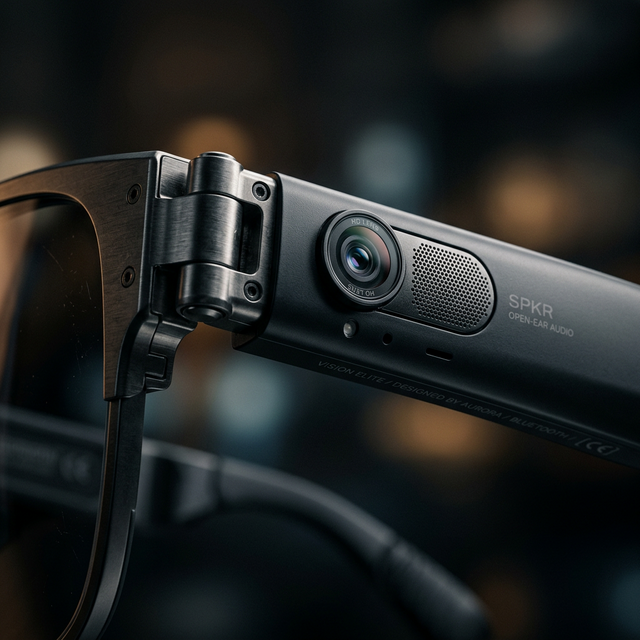
The term “smart glasses” is an umbrella category. Depending on their primary function, they can also be referred to as AR glasses, AI glasses, audio glasses, camera glasses, or XR (extended reality) glasses.
📋 Quick Recaps: What Are Smart Glasses?
- Smart glasses are face-worn wearable computing devices with embedded electronics
- Core components include processors, audio systems, cameras, sensors, and optional displays
- They serve as a hands-free interface for communication, navigation, and content consumption
- Limitation: Current models vary greatly in price and capability, from $30 audio frames to $3,500+ AR headsets
- Perfect for: Distributors and brand owners seeking the next big wearable category beyond smartwatches
Types of Smart Glasses: A Complete Classification
Not all smart glasses are created equal. Understanding the different types is crucial for B2B sellers deciding which category to invest in. Here is a classification based on primary function:
1. Audio Smart Glasses
Audio smart glasses are designed primarily for wireless audio playback and hands-free calling. They look and feel like regular eyeglasses or sunglasses but feature built-in speakers (typically open-ear or bone conduction) and microphones in the temples.
Leading examples include the Ray-Ban Meta Smart Glasses (developed in partnership with EssilorLuxottica and Meta), Bose Frames, and Amazon Echo Frames. These devices prioritize fashion-forward design and daily wearability over advanced computing features.
Audio smart glasses are an excellent entry point for B2B sellers new to the smart eyewear market because they have a lower price point ($150–$400 retail), broad consumer appeal, and a simple technology stack that is relatively easy to manufacture via OEM partnerships.
📋 Quick Recaps: Audio Smart Glasses
- Primary function is wireless audio and hands-free phone calls
- Look like normal glasses — prioritize fashion and comfort
- Lower price point ($150–$400), broad consumer appeal
- Limitation: Limited by lack of visual display and camera features
- Perfect for: Fashion-focused brands, lifestyle retailers, and audio accessory sellers
2. Camera Smart Glasses
Camera smart glasses feature one or more built-in cameras, enabling the wearer to capture photos and videos from a first-person perspective. This “point-of-view” capture capability is appealing for content creators, travelers, sports enthusiasts, and professionals who need hands-free documentation.
The Snap Spectacles and the Ray-Ban Meta glasses (which combine audio + camera + AI features) are popular consumer examples. In the enterprise space, companies like Vuzix offer camera-equipped smart glasses for remote-assistance and inspection workflows.
Privacy concerns are a notable trade-off with camera-enabled smart glasses. Some regions have strict regulations regarding recording in public spaces, and social acceptance varies by culture — a factor B2B sellers must consider when choosing target markets.
📋 Quick Recaps: Camera Smart Glasses
- Built-in cameras for first-person photo and video capture
- Popular among content creators, travelers, and field workers
- Limitation: Social and legal privacy concerns in certain markets
- Higher ASP (Average Selling Price) compared to audio-only glasses
- Perfect for: Action camera brands, content creator accessory sellers, and enterprise solution providers
3. AR (Augmented Reality) Display Smart Glasses
AR smart glasses are the most technologically advanced category. They feature a transparent display — often based on waveguide optics, micro-OLED, or micro-LED projection — that overlays digital content (text, images, 3D models, navigation arrows) directly onto the wearer’s view of the real world.

Major players include Apple Vision Pro, XREAL Air, Microsoft HoloLens 2, and emerging Chinese brands like RayNeo and INMO.
AR display glasses have the highest average selling price (ASP) in the category, ranging from $300 for basic HUD (heads-up display) models to $3,500+ for full spatial computing headsets. While consumer adoption is still in its early stages, enterprise applications in manufacturing, logistics, healthcare, and field service are already generating significant B2B demand.
📋 Quick Recaps: AR Display Smart Glasses
- Transparent digital display overlay on the real world using advanced optics
- Highest technology complexity and highest ASP ($300–$3,500+)
- Strong enterprise demand in manufacturing, logistics, field service, and healthcare
- Limitation: Consumer adoption still early — limited by battery life, weight, and social acceptance
- Perfect for: Enterprise solution resellers, tech distributors, and brands targeting premium early adopters
4. AI-Powered Smart Glasses
AI-powered smart glasses represent the fastest-growing sub-category. These devices integrate on-device or cloud-based artificial intelligence to enable features like:
- Real-time language translation (visual and audio)
- Object and scene recognition (“What am I looking at?”)
- Contextual AI assistants (accessed through voice and camera input on your glasses)
- Live captioning for the hearing impaired
The Ray-Ban Meta glasses with Meta AI, and standalone AI glasses from emerging brands, exemplify this trend. The key selling point is that AI “sees what you see” through the camera and provides intelligent, contextual responses through the speaker — no screen required.
For B2B sellers, AI-enabled smart glasses offer a powerful differentiation story: you aren’t just selling a gadget; you’re selling a personal AI assistant that lives on the user’s face.
📋 Quick Recaps: AI-Powered Smart Glasses
- AI (cloud or on-device) enables translation, recognition, and contextual assistance
- Fastest-growing sub-category driven by the global AI boom
- Does not necessarily require a visual display — AI responses can be audio-only
- Limitation: Dependent on cloud connectivity for advanced AI features, which can introduce latency
- Perfect for: Tech-forward brands, AI product distributors, and accessibility-focused retailers
5. Enterprise / Industrial Smart Glasses
Enterprise smart glasses are designed specifically for professional use in industries like manufacturing, warehousing, logistics, healthcare, energy, and field maintenance. They emphasize ruggedness, hands-free operation, and integration with enterprise software platforms.
Google Glass Enterprise Edition (now discontinued but historically pivotal), Vuzix M400, and RealWear Navigator 500 are representative products. Features typically include barcode scanning, remote expert video assistance, step-by-step digital work instructions overlaid on the field of view, and voice-controlled navigation of industrial systems.
📋 Quick Recaps: Enterprise Smart Glasses
- Designed for industrial and professional environments (factory, warehouse, healthcare)
- Features include remote assistance, barcode scanning, digital work instructions
- Limitation: Rugged, purpose-built designs; not fashion-oriented
- Higher price point but sold in bulk B2B orders with recurring software/SaaS revenue
- Perfect for: Industrial supply distributors, enterprise IT resellers, and vertical solution integrators
Smart Glasses Market Trends and Growth Drivers
The global smart glasses market is experiencing a significant surge, fueled by converging trends across technology, consumer behavior, and enterprise digitalization. Understanding these trends is critical for any B2B seller evaluating this product category.
1. The AI Boom Is Accelerating Adoption
The explosive growth of large language models (LLMs) and multimodal AI in 2024–2026 has created a perfect storm for smart glasses. AI needs a “physical interface” — and glasses, positioned right in front of the eyes and ears, are arguably the most natural wearable form factor.
2. Consumer Awareness Is Reaching Critical Mass
Unlike the early Google Glass era, which was met with public skepticism, today’s consumers are far more receptive to face-worn technology. The normalization of AirPods and mainstream success of VR headsets have collectively lowered the barrier to smart glasses adoption.
3. Enterprise ROI Is Proven
In the enterprise segment, the return on investment for smart glasses has been well-documented. Companies deploying smart glasses for remote-assist and hands-free workflows have reported 25–35% reduction in task completion time and 30–50% reduction in error rates.
4. Price Points Are Becoming Accessible
As component costs decrease and manufacturing scales up (particularly in Shenzhen’s mature consumer electronics supply chain), smart glasses are becoming accessible at price points that make sense for mass-market distribution.
Why Selling Smart Glasses Is a Good Business in 2026?
For distributors, brand owners, and e-commerce sellers already selling wearables like smartwatches and earbuds, expanding into smart glasses is a logical and potentially highly profitable next step.
- First-Mover Advantage in a Blue Ocean Market. The smart glasses market is still in its early growth phase — fewer established brands, fewer saturated channels, and more white space.
- High Profit Margins. Smart glasses command higher ASPs than smartwatches. Even entry-level audio glasses retail at $150–$300 with healthy wholesale margins.
- Recurring Revenue Potential. Many models are tied to companion apps, cloud AI services, or subscription-based software platforms.
- Growing Global Demand Across Verticals. Demand is growing simultaneously across consumer electronics, enterprise/industrial, healthcare, education, sports, and tourism.
Looking for OEM Smart Glasses?
Want to launch your own branded smart glasses line? Tired of selling generic, undifferentiated products? Looking for a manufacturing partner who can deliver custom designs, reliable quality, and competitive factory-direct pricing?
At [Your Company], we specialize in OEM and ODM smart glasses manufacturing, offering end-to-end solutions from concept design to mass production.
- Custom Industrial Design: Your unique frame shape, color, material (TR90, titanium, acetate, nylon).
- Custom Branding: Logo engraving, branded packaging, retail-ready presentation.
- Audio System Options: Open-ear directional speakers, bone conduction modules, dual-microphone arrays.
- Camera & AI Integration: High res cameras with privacy LED indicators, dedicated companion app development.
- AR Display Integration: Waveguide, birdbath, or micro-OLED display modules.
| Service Element | Value Added |
|---|---|
| Factory Scale | Over 15 years in wearable tech OEM. |
| Certifications | ISO9001, CE, FCC, RoHS compliant. |
Key Technical Factors That Affect Smart Glasses Performance
Battery Life: One of the biggest constraints. Most smart glasses offer 3–6 hours of active use, limited by the small form factor that restricts battery capacity. AI and AR features consume significantly more power than audio-only modes.
Weight and Comfort: Consumer acceptance is heavily influenced by device weight. Target weight for all-day wearable smart glasses is under 50 grams. Heavier devices (70–120g) are acceptable for task-specific enterprise use.
Audio Quality vs. Privacy: Achieving good audio volume and bass response while minimizing sound leakage requires sophisticated speaker and acoustic chamber design.
Lens Compatibility: Some smart glasses support prescription lens inserts, significantly expanding the addressable market. Approximately 75% of adults use some form of vision correction.
Conclusion
Smart glasses are no longer a futuristic concept — they are a rapidly maturing product category with proven demand across both consumer and enterprise markets. From audio frames that look like regular sunglasses to AI-powered devices that serve as personal assistants and AR platforms, the market offers diverse products at diverse price points.
For B2B sellers, 2026 presents a strategic window of opportunity. The market is growing fast, competition is manageable, profit margins are attractive, and the global supply chain is mature enough to support scalable OEM production at competitive costs.